
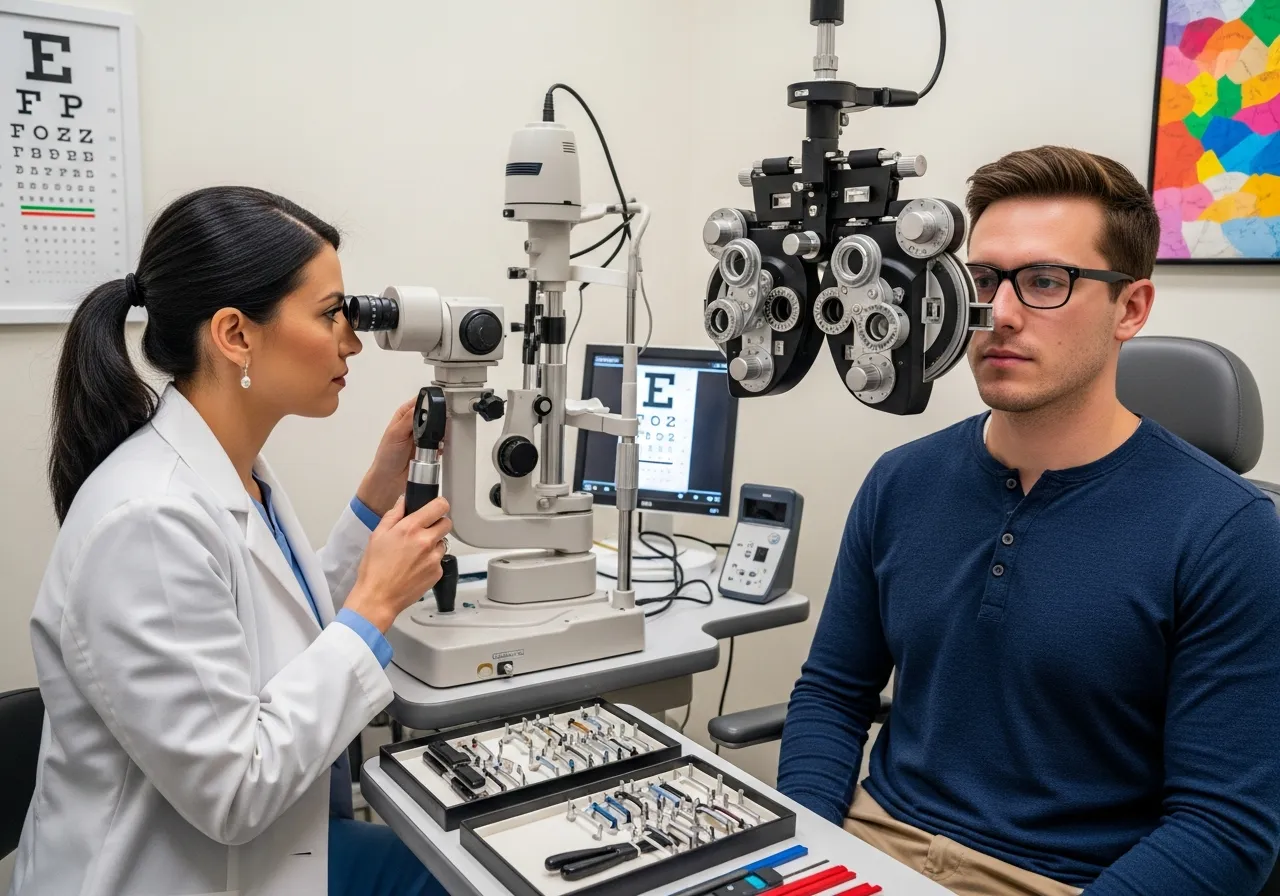
Choosing an eye doctor is one of those decisions people tend to make quickly and then keep for decades. Many patients pick whoever is closest, whoever their insurance lists first, or whoever a friend happened to mention — and then stay for twenty years. That is not necessarily a bad thing, because a long relationship with one optometrist is genuinely valuable. But it does mean the choice is worth making thoughtfully the first time.
If you live in Westchester or the surrounding 90045 area, you have plenty of options within a short drive, from Playa del Rey and Playa Vista to Culver City, El Segundo, Ladera Heights, and Marina del Rey. Convenience matters — nobody wants a long commute for an annual exam near LAX — but proximity should be only one factor among several. What actually separates a good routine eye visit from an excellent, health-protecting one is the depth of the exam, the technology behind it, and the doctor's willingness to know you as a patient over time.
At Westchester Vision Care in the Westchester neighborhood of Los Angeles, Dr. Jennifer Tabiza cares for patients age 10 and older, and the questions below are the same ones we encourage every prospective patient to ask — of us or of anyone they are considering.
Comprehensive Exams vs. Quick Vision Checks
The single most important thing to understand is the difference between a vision screening and a comprehensive eye exam. A screening — the kind offered at a school, a health fair, or a retail vision counter — usually just checks whether you can read the chart and roughly what lenses you need. A comprehensive exam evaluates the health of the entire eye, inside and out, and screens for conditions that produce no early symptoms at all.
When you evaluate an eye doctor, ask what a routine visit actually includes. A strong comprehensive exam should cover refraction for your glasses or contacts, binocular vision and focusing, eye pressure, and a careful look at the retina and optic nerve. Conditions like glaucoma, diabetic eye disease, and macular degeneration are frequently caught during a routine exam long before the patient notices anything wrong — but only if the exam is thorough enough to catch them.
A practice that treats the annual exam as a five-minute prescription check is giving you far less than a practice that treats it as a full ocular health evaluation. That distinction is worth more than any convenience factor.
Technology That Actually Changes Your Care
Ask what diagnostic technology the practice uses, because it directly affects what your doctor can see. Two tools in particular have transformed routine eye care in recent years, and both are worth asking about.
• Optical coherence tomography (OCT) — a scan that images the layers of the retina and optic nerve in cross-section, revealing subtle changes years before they would be visible otherwise. It is central to catching glaucoma and macular degeneration early.
• Ultra-widefield retinal imaging — technology that captures a far larger view of the retina in a single image, helping detect peripheral problems that a standard exam might miss.
You do not need to become an expert in these devices. The point is simply that a practice investing in modern imaging is a practice equipped to catch problems early. When you call, it is entirely reasonable to ask whether the doctor uses OCT and widefield retinal imaging as part of the exam.
Scope of Care: Can They Handle More Than Glasses?
Your eyes are not only a vision-correction problem; they are a health system that can develop disease, irritation, and injury. A well-rounded optometrist should be able to manage far more than an updated prescription. Ask whether the practice handles dry eye disease, sudden red or painful eyes, foreign-body removal, contact lens fittings including specialty lenses, and co-management of procedures like LASIK or cataract surgery.
This matters practically. When you wake up on a Saturday with a red, watering, light-sensitive eye, you want a home practice that can see you promptly rather than send you to urgent care. When your eyes are chronically dry from screen work or the dry cabin air so common among people who work near LAX, you want a doctor who treats the root cause rather than handing you a sample of drops.
A practice with a broad scope of care becomes your eyes' medical home — the place that knows your history and can act on it — instead of a once-a-year vending machine for prescriptions.
Questions Worth Asking Before You Book
A short phone call can tell you a lot about whether a practice is the right fit. Consider asking:
• Does the doctor personally perform the exam, and how long is a typical comprehensive visit?
• What imaging and diagnostic technology is used during a routine exam?
• Does the practice manage medical eye issues like dry eye, infections, and injuries, or only prescriptions?
• How does billing work for my situation — will this go through a vision plan, medical insurance, or both?
• What is the availability for urgent problems like a sudden red or painful eye?
• What age range does the practice see, and does it accommodate the whole family?
The answers will quickly reveal whether you are looking at a full-service eye care home or a quick-turnaround retail stop. Both exist in the 90045 area, and knowing which you are choosing is half the battle.
The Value of a Long-Term Relationship
The best eye care is longitudinal, meaning it compares you to yourself over time. Many of the most serious eye conditions are detected not by a single dramatic finding but by a small, drift-level change from one year to the next. A doctor who has your baseline scans and knows your history can spot those changes; a doctor seeing you for the first time cannot.
That is why choosing well the first time pays off. When you find an optometrist who examines thoroughly, invests in good technology, communicates clearly, and is conveniently located for your life in Westchester or a neighboring community, staying with that practice year after year builds a record that protects your vision.
Location still counts, of course. Being able to reach your eye doctor easily from Playa Vista, El Segundo, or wherever near LAX you spend your days makes it far more likely you will actually keep your annual appointments — and consistency is what keeps eyes healthy.
Make Westchester Vision Care Your Eye Care Home
If you are weighing your options for an eye doctor in the 90045 area, we invite you to bring the questions above to us. We believe a great eye exam is thorough, unhurried, technology-supported, and built on a relationship that lasts.
Dr. Jennifer Tabiza sees patients age 10 and older at Westchester Vision Care in the Westchester neighborhood of Los Angeles, CA 90045, convenient to Playa del Rey, Playa Vista, El Segundo, Culver City, and the greater LAX area. To schedule a comprehensive eye exam, call (310) 670-1888 or book online today.
See an eye doctor in Westchester, Los Angeles
We welcome patients from Playa Vista, Marina del Rey, Playa del Rey, El Segundo and the surrounding 90045 neighborhoods.
8610 S Sepulveda Blvd #100, Los Angeles, CA 90045 · (310) 670-1888
Book a ConsultationThis article provides general education, not a diagnosis or individualized medical advice. Please see an eye care professional about your specific symptoms.