
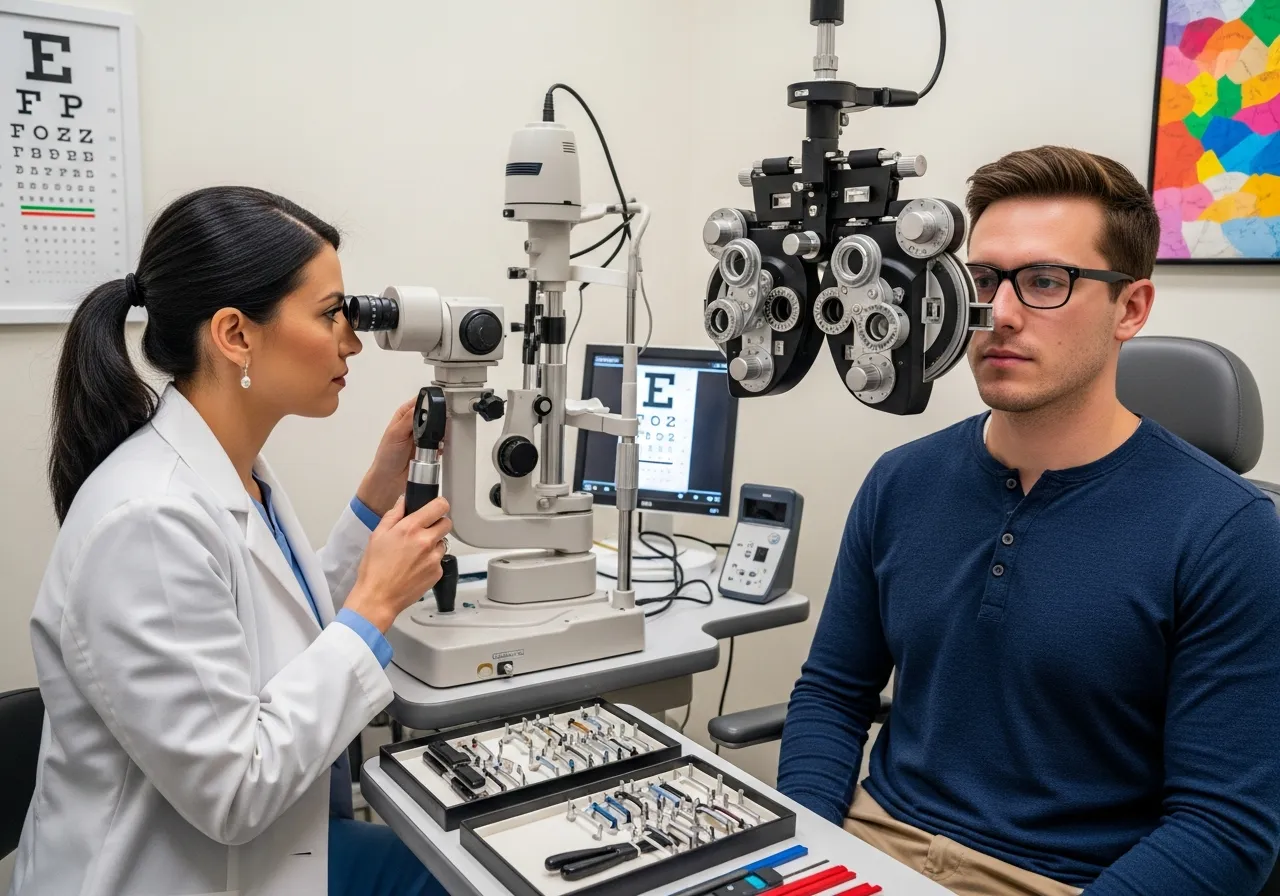
Most people assume that if a child can read the letters on the eye chart, their vision is fine. But 20/20 eyesight only measures how sharply you see a still object at a distance. It says nothing about whether the two eyes work together, whether they can shift focus quickly from the board to the desk, or whether the brain can accurately track a line of text without losing its place. These are learned, trainable skills — and when they do not develop well, a child can have perfect eyesight and still struggle to read, concentrate, or keep up in class.
Vision therapy is a personalized program of eye and brain exercises designed to build and strengthen exactly those skills. It is prescribed and supervised by an eye doctor after a careful evaluation, and it is used for both children and adults. At Westchester Vision Care in the Westchester neighborhood of Los Angeles, Dr. Jennifer Tabiza evaluates patients age 10 and older to determine whether visual skill deficits are getting in the way of reading, learning, work, or sports — and whether therapy can help.
If you have a child who avoids reading, loses their place constantly, or complains of tired eyes and headaches despite a clean eye exam, the problem may not be their eyesight at all. It may be how their visual system is functioning.
What Vision Therapy Actually Treats
Vision therapy is not about making the eyes physically stronger the way lifting weights strengthens a muscle. It is about improving the coordination and communication between the eyes and the brain. The goal is smoother, faster, more automatic visual function so that seeing takes less effort and the brain is free to focus on comprehension and performance.
Common conditions and skill deficits that vision therapy addresses include:
• Convergence insufficiency — difficulty turning both eyes inward together to focus on near work, a leading cause of eye strain during reading.
• Eye teaming problems — when the two eyes do not aim at the same point, causing double vision, suppression of one eye, or fatigue.
• Focusing (accommodative) problems — trouble shifting focus quickly and comfortably between near and far.
• Tracking difficulties — jerky or inaccurate eye movements that make following a line of text or a moving ball hard.
• Amblyopia and strabismus — reduced vision in one eye or a turned eye, often treated alongside or after other interventions.
• Visual processing weaknesses — difficulty interpreting and remembering what the eyes see.
These issues frequently masquerade as attention problems, learning difficulties, or simple laziness, which is why so many children go undiagnosed for years.
Signs That the Visual System May Be Struggling
Because children rarely know that their vision is different from anyone else's, they seldom complain in ways adults recognize. Instead, the signs tend to show up as behavior and performance. Watch for a child who skips or rereads lines, uses a finger to keep their place, holds reading material unusually close, or covers one eye to focus.
Other red flags include short attention span for near tasks, frequent headaches or eye rubbing after homework, reversing letters beyond the age where that is typical, poor reading comprehension despite good intelligence, and clumsiness in sports or catching a ball. Adults can experience symptoms too — eye strain at the computer, difficulty concentrating on reading, or lingering visual problems after a concussion or brain injury.
None of these signs prove a vision problem on their own, but together they justify a thorough evaluation. The exam Dr. Tabiza performs looks well beyond the eye chart to measure how the visual system performs under real working conditions.
What a Vision Therapy Program Looks Like
A vision therapy program always starts with a comprehensive assessment to identify which specific skills are weak and to rule out other causes. From there, a customized plan is built around the individual's needs and goals.
Sessions typically combine in-office activities with home reinforcement. Therapy may use tools such as specialized lenses and prisms, filters, balance and coordination equipment, computer-based exercises, and targeted eye-movement drills. Each activity is chosen to challenge a particular skill and is progressively made harder as the patient improves, much like physical therapy for the body.
Programs vary in length depending on the diagnosis and how the patient responds, and consistency matters far more than intensity. The repeated, gradual practice is what allows new visual skills to become automatic. Progress is monitored throughout so the plan can be adjusted as the visual system develops.
Why It Matters Beyond the Classroom
Efficient visual skills touch nearly every part of daily life. For students, they support reading fluency, comprehension, and the stamina to work without fatigue. For athletes, they underpin reaction time, hand-eye coordination, and depth judgment. For adults, they affect comfort at the computer, driving confidence, and recovery after a head injury.
When the visual system works smoothly, the brain no longer has to spend energy just keeping the image clear and single — that energy is freed up for learning, thinking, and performing. Many families are surprised to see improvements not only in reading but in confidence and willingness to engage with tasks their child used to avoid.
Vision therapy is not a quick fix or a cure for every learning challenge, and it works best when expectations are realistic and the diagnosis is accurate. That is exactly why a proper evaluation comes first.
Take the First Step
If reading, learning, or visual comfort has been a struggle despite a clean eye chart, a functional vision evaluation can reveal what a standard screening misses. Understanding the root cause is the first step toward meaningful, lasting improvement.
Dr. Jennifer Tabiza sees patients age 10 and older at Westchester Vision Care in the Westchester neighborhood of Los Angeles, CA 90045. To schedule a vision evaluation and learn whether vision therapy could help you or your child, call (310) 670-1888 or book online today.
See an eye doctor in Westchester, Los Angeles
We welcome patients from Playa Vista, Marina del Rey, Playa del Rey, El Segundo and the surrounding 90045 neighborhoods.
8610 S Sepulveda Blvd #100, Los Angeles, CA 90045 · (310) 670-1888
Book a ConsultationThis article provides general education, not a diagnosis or individualized medical advice. Please see an eye care professional about your specific symptoms.