
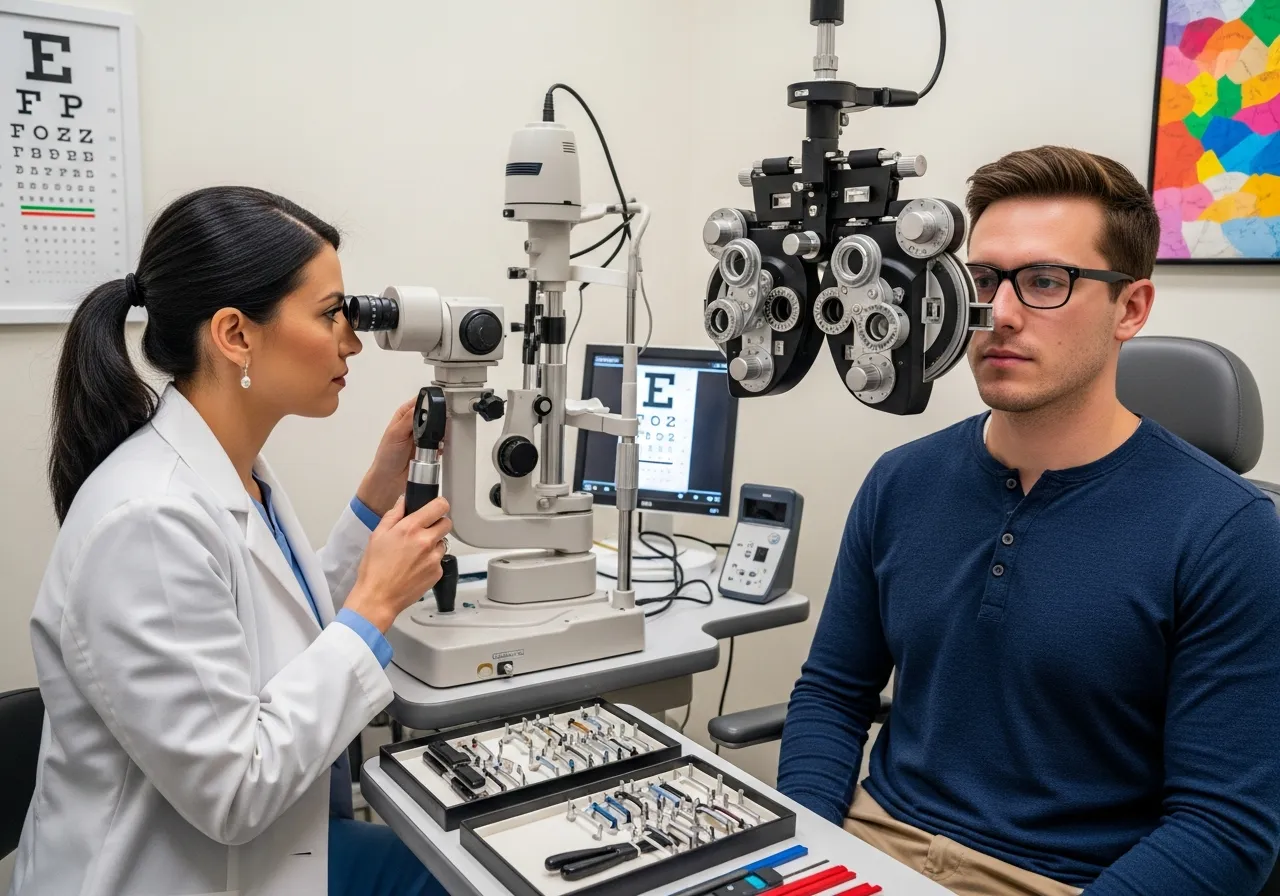
If you have ever sat behind that large, dial-covered instrument while your eye doctor flipped lenses and asked "one or two, two or three?" you have experienced a refraction. It is the part of the eye exam most people associate with getting glasses, and for good reason — the refraction is how your precise prescription is determined.
But the refraction test is more nuanced than a simple guessing game. It measures how light bends as it enters your eye and pinpoints exactly what correction you need to see clearly at every distance. Getting it right is both a science and an art, blending objective measurements with your own feedback. At Westchester Vision Care in the Westchester neighborhood of Los Angeles, Dr. Jennifer Tabiza uses the refraction to build a prescription that is comfortable and accurate for the way you actually use your eyes.
What a Refractive Error Actually Is
To understand the test, it helps to understand what it is measuring. For you to see clearly, light entering the eye must focus precisely on the retina at the back. When the shape or length of the eye causes light to focus slightly in front of or behind the retina, the result is a refractive error — and blurred vision.
The common refractive errors are:
• Myopia (nearsightedness), where distant objects look blurry but close objects are clear.
• Hyperopia (farsightedness), where near objects — and sometimes distant ones — are harder to focus on.
• Astigmatism, caused by an irregularly shaped cornea or lens, which blurs vision at all distances.
• Presbyopia, the age-related loss of near focusing ability that typically begins in the mid-40s.
The refraction quantifies these errors so they can be corrected with lenses that redirect light to land exactly on the retina.
Objective vs. Subjective Refraction
A modern refraction usually combines two approaches. The first, objective refraction, uses instruments to estimate your prescription without requiring answers from you. An autorefractor shines light into the eye and measures how it reflects back, producing a starting point in seconds. In some cases, the doctor performs retinoscopy, shining a light into the eye and observing the reflex from the retina — a skilled, hands-on technique especially useful for children or anyone who cannot reliably describe what they see.
The second approach is subjective refraction, the familiar "which is better" portion. Using the phoropter — that dial-covered instrument — Dr. Tabiza presents different lens choices and asks which produces the clearer image. Your responses refine the objective starting point into a prescription that reflects your personal visual experience. Both parts matter: the instruments provide precision, and your feedback ensures the final result feels right to you.
Why Your Answers Matter
Patients often worry about "getting it wrong" during the subjective refraction. The good news is that the test is designed to be forgiving. Many of the choices are intentionally close together or nearly identical, which lets the doctor zero in on your true correction and confirm consistency. If two options genuinely look the same, saying so is helpful information, not a mistake.
It also helps to relax your eyes rather than straining to force clarity. Focusing effort can temporarily change the measurement, especially in younger patients whose eyes have strong focusing power. If your eyes feel tired or you are unsure, it is completely fine to ask to see a comparison again. The goal is your best, most comfortable vision — not the strongest lens possible.
Beyond the Numbers: Balancing the Prescription
A prescription is more than a set of numbers on a card. After determining the correction for each eye, Dr. Tabiza balances the two eyes so they work comfortably together and checks how the prescription performs at the distances you rely on most. Someone who spends the day at a computer has different needs than someone who drives for a living, and the prescription can be tuned accordingly.
For patients over 40, the refraction also accounts for presbyopia, guiding decisions about reading glasses, bifocals, or progressive lenses. The refraction is where those conversations begin — matching the optics to your lifestyle so your new glasses or contacts feel natural from the first day rather than something you have to "get used to."
Refraction Is One Part of a Complete Exam
It is worth remembering that the refraction determines your prescription but does not check the health of your eyes. That is why a comprehensive exam also includes an evaluation of the cornea, lens, retina, optic nerve, and eye pressure. Clear vision and healthy eyes are two different things, and a thorough exam addresses both.
If it has been a while since your last exam, or your current glasses no longer feel sharp, a fresh refraction can make a noticeable difference. Dr. Jennifer Tabiza sees patients age 10 and older at Westchester Vision Care in Westchester, Los Angeles, CA 90045. To schedule your comprehensive eye exam and get a prescription dialed in to your everyday vision, call (310) 670-1888 or book online.
See an eye doctor in Westchester, Los Angeles
We welcome patients from Playa Vista, Marina del Rey, Playa del Rey, El Segundo and the surrounding 90045 neighborhoods.
8610 S Sepulveda Blvd #100, Los Angeles, CA 90045 · (310) 670-1888
Book a ConsultationThis article provides general education, not a diagnosis or individualized medical advice. Please see an eye care professional about your specific symptoms.