
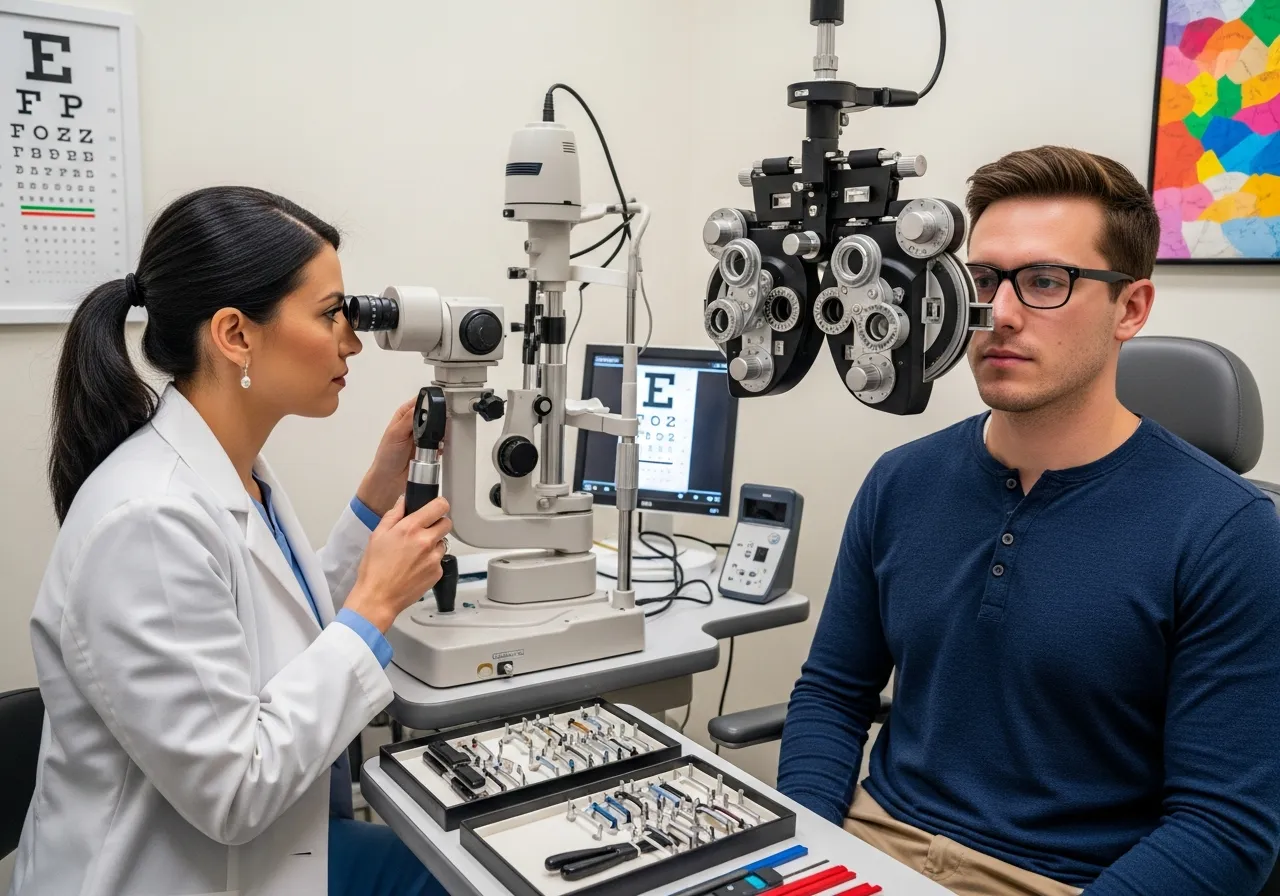
The stretch of the Westside anchored by Playa Vista has earned the nickname Silicon Beach for good reason — it is packed with technology, media, gaming, and creative companies whose employees spend the majority of their waking hours staring at monitors. If you work in that world, your eyes are doing heavy lifting every single day, and many people feel it by midafternoon.
The symptoms are consistent and recognizable: tired, achy eyes, intermittent blurriness that clears when you blink, dryness and irritation, headaches, and difficulty shifting focus between your screen and the room. This cluster of complaints has a name — digital eye strain, sometimes called computer vision syndrome — and it affects a huge share of knowledge workers.
At Westchester Vision Care in the Westchester neighborhood of Los Angeles, minutes from Playa Vista, Dr. Jennifer Tabiza sees patients age 10 and older and helps screen-heavy professionals understand what is actually happening to their eyes and what genuinely helps. Spoiler: the answer is more about how you work than about any single product.
What Really Causes Digital Eye Strain
The most important thing to understand is that screens strain the eyes primarily through how we use them, not through some mysterious property of the display. Two mechanisms do most of the damage.
The first is reduced blinking. When we concentrate on a screen, our blink rate drops dramatically, and the blinks we do manage are often incomplete. Blinking is what spreads a fresh layer of tears across the eye, so less blinking means the surface dries out, leading to grittiness, burning, and fluctuating vision. This is why long screen sessions feel so much worse than an equal amount of time doing almost anything else.
The second is sustained focusing effort. Looking at something close-up for hours requires the eye's focusing muscles to stay contracted, and holding that contraction leads to fatigue, much like any muscle held in one position too long. Combine chronic near focus with reduced blinking, and you have the perfect recipe for the tired, dry, blurry eyes so common in tech work.
Blue Light: Facts vs. Myths
Few topics in eye care generate as much marketing as blue light. It is worth separating what is supported from what is oversold. Blue light is simply part of the visible spectrum, and by far the largest source of it in your life is the sun — screens emit a tiny fraction by comparison.
The most credible concern about screen blue light is not damage to the eye but its effect on sleep. Blue-wavelength light in the evening can suppress melatonin and disrupt your circadian rhythm, which is a real reason to reduce screen exposure or use night-shift display settings in the hours before bed. That benefit is about sleep quality, not about protecting the eye tissue itself.
The claim that everyday screen blue light causes lasting eye damage is not well supported by current evidence. When people feel better after switching to blue-light glasses, the relief usually comes from taking breaks, blinking more, or an updated prescription — not from filtering blue light specifically. If blue-light lenses help you and you like them, there is no harm in wearing them, but they are not a cure for digital eye strain.
Setting Up a Screen Workstation That Protects Your Eyes
How you arrange your workspace has a bigger impact on eye comfort than most gadgets. A few evidence-based adjustments go a long way:
• Position the top of your monitor at or slightly below eye level, so you look slightly downward. This keeps more of the eye surface covered by the eyelid and reduces evaporation.
• Keep the screen roughly an arm's length away, and increase text size rather than leaning in.
• Reduce glare from windows and overhead lighting, and match your screen brightness to the room rather than working with a bright display in a dim space.
• Aim air conditioning and fans away from your face, since airflow accelerates tear evaporation.
• Follow the 20-20-20 rule: every 20 minutes, look at something about 20 feet away for around 20 seconds to relax the focusing muscles and prompt full blinks.
These changes cost little and, practiced consistently, meaningfully reduce end-of-day fatigue.
Dry Eye in the Screen Generation
For many tech workers, digital eye strain overlaps with genuine dry eye disease. Years of reduced blinking during long screen days can stress the tear film and the meibomian glands that keep it stable, and dry eye is showing up earlier in life than it used to precisely because of screen habits.
If your eyes feel dry, gritty, or burning even away from your desk, or if artificial tears only help for a few minutes, the issue may be more than temporary strain. A dry eye evaluation looks at the actual health of your tear film and glands and can distinguish simple screen fatigue from a condition that benefits from treatment. Catching it early is far easier than reversing it later, since dry eye tends to progress when left unmanaged.
The Role of an Up-to-Date Prescription
One overlooked cause of screen fatigue is an outdated or imperfect prescription. If your eyes are working harder than they should to keep the screen clear, strain follows. Some people benefit from a prescription optimized for the intermediate distance where a monitor sits, which is different from a general distance or reading prescription.
A comprehensive eye exam can pinpoint whether your correction is contributing to your symptoms and whether a computer-specific lens design would help. For people over 40, the natural change in near focus called presbyopia adds another layer, and the right lens strategy can transform comfort at the desk. An exam is also the moment to screen for eye health issues that produce no symptoms — a smart investment for anyone spending their days on screens.
Work Smarter for Your Eyes — Book an Exam
If your Silicon Beach workday leaves your eyes exhausted, the fix is usually a combination of better habits, a dialed-in prescription, and addressing any underlying dry eye — not a single miracle product. A comprehensive exam is the place to build that plan.
Dr. Jennifer Tabiza sees patients age 10 and older at Westchester Vision Care in the Westchester neighborhood of Los Angeles, CA 90045, just minutes from Playa Vista and the Silicon Beach corridor. To schedule an eye exam, call (310) 670-1888 or book online today.
See an eye doctor in Westchester, Los Angeles
We welcome patients from Playa Vista, Marina del Rey, Playa del Rey, El Segundo and the surrounding 90045 neighborhoods.
8610 S Sepulveda Blvd #100, Los Angeles, CA 90045 · (310) 670-1888
Book a ConsultationThis article provides general education, not a diagnosis or individualized medical advice. Please see an eye care professional about your specific symptoms.