
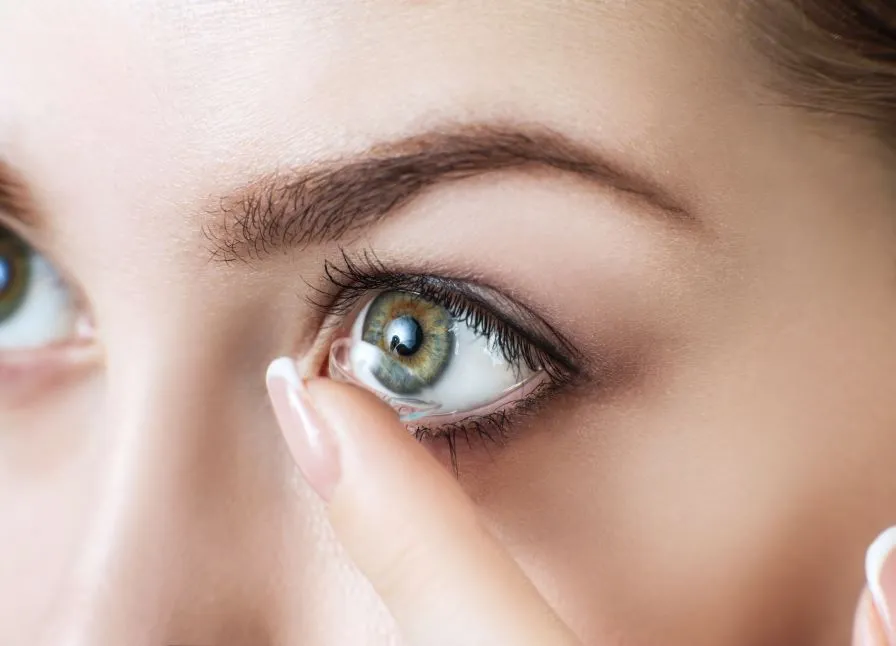
The Silicon Beach corridor around Playa Vista is packed with people who stare at screens for a living — software engineers, video editors, designers, marketers, and everyone in between. If that is you, your eyes are working hard from the first login to the last late-night edit, and by the end of the day they often feel dry, tired, and strained.
It is no surprise, then, that blue-light filtering products are everywhere, including in contact lenses. The ACUVUE OASYS MAX 1-Day family features the OptiBlue Light Filter, described by ACUVUE as the highest level of blue-violet light filtering available in a contact lens, and it pairs that with TearStable Technology aimed at keeping the lens comfortable through a long day. Both features are genuine and worth understanding.
But it is just as important to be honest about what blue-light filtering can and cannot do, because the marketing around blue light often outruns the science. At Westchester Vision Care in the Westchester neighborhood of Los Angeles, minutes from Playa Vista, Dr. Jennifer Tabiza fits patients age 10 and older and helps screen-heavy professionals make informed choices. Here is a clear-eyed look at these lenses.
What the OptiBlue Light Filter Actually Is
The ACUVUE OASYS MAX 1-Day lenses incorporate what ACUVUE calls the OptiBlue Light Filter, which filters a portion of blue-violet light — the company describes it as filtering roughly 60% of blue-violet light and cites it as the highest level of blue-violet light filtering among contact lenses. Blue-violet light sits at the shorter-wavelength, higher-energy end of the visible spectrum.
One practical benefit of filtering some of that high-energy light is a reduction in the scattering of light that can affect visual quality, which some wearers notice as slightly crisper or more comfortable vision, particularly in demanding lighting. It is a built-in feature of the lens material rather than a coating that wears off, so if you wear these lenses you get the filter automatically.
The key word, though, is "a portion." The filter reduces some blue-violet light; it does not block all blue light, and it is not intended to. Understanding that boundary is essential to having realistic expectations about what the lens will and will not change in your daily experience.
An Honest Take on What Blue-Light Filtering Does — and Doesn't Do
This is where it pays to separate the science from the sales pitch. By far the largest source of blue light in your life is the sun, not your screens — a monitor emits only a tiny fraction by comparison. So the idea that filtering screen blue light is protecting your eyes from major harm does not hold up well.
The most credible concern about blue light is not damage to the eye but its effect on sleep, since blue-wavelength light in the evening can suppress melatonin and disrupt your circadian rhythm. That is a real reason to limit evening screens or use night-mode settings — but it is about sleep quality, and it is not something a daytime contact lens is designed to solve.
Just as important: the leading, best-supported cause of screen-related eye discomfort is not blue light at all. It is dry eye and eye strain from reduced blinking and sustained close focus during long screen sessions. So if your eyes feel tired and gritty at 5 p.m., a blue-light filter is unlikely to be the main fix. Current evidence does not support the claim that everyday screen blue light causes lasting eye damage, and blue-light filtering is best thought of as a modest, no-downside feature rather than a cure for digital eye strain. If a lens with the filter is otherwise the right lens for you, there is no harm in having it — just do not expect it to do more than it can.
TearStable Technology: The Feature That May Matter More
For screen-heavy wearers, the more impactful feature of the OASYS MAX 1-Day family may not be the blue-light filter at all — it may be TearStable Technology. This is a lens material and design engineered to help stabilize the tear film and keep the lens comfortable through a long day, addressing the end-of-day dryness that drives so many people to give up on their contacts.
This matters because the number-one reason people abandon contact lenses is discomfort, especially the dry, tired feeling that creeps in after many hours of wear and screen time. Long screen sessions dramatically reduce how often you blink, which destabilizes the tear film and makes lenses feel drier. A lens built to help maintain tear-film stability is directly targeting the actual mechanism behind most screen-related contact lens discomfort.
In other words, for a Silicon Beach professional squinting at a monitor all day, the comfort technology may deliver a more noticeable everyday benefit than the blue-light filter. Both come together in the same daily disposable lens, so you do not have to choose — but it is worth knowing which feature is doing the heavy lifting for how your eyes feel.
The Bigger Picture for Screen-Heavy Eyes
No contact lens, however advanced, replaces good screen habits. If your eyes are strained from long days at the monitor, the highest-value changes are behavioral and cost nothing:
• Follow the 20-20-20 rule — every 20 minutes, look at something about 20 feet away for around 20 seconds to relax your focusing muscles and prompt a full blink.
• Blink fully and consciously during long tasks, since concentration cuts your blink rate and leaves the eye surface exposed.
• Position your monitor slightly below eye level and about an arm's length away, and aim air conditioning away from your face.
• Keep preservative-free rewetting drops approved for your lenses on hand for long screen days.
If your eyes stay dry, gritty, or burning even away from your desk, that may signal genuine dry eye disease rather than ordinary strain, and a dry eye evaluation can tell the difference. A comfortable, well-fitted lens plus smart habits will always beat any single feature working alone.
Find the Right Lens for Your Screen Life at Westchester Vision Care
If you spend your days on screens and want a comfortable daily lens that also happens to include the OptiBlue Light Filter, the ACUVUE OASYS MAX 1-Day family is worth a look — but the right lens for you depends on your eyes, your prescription, and a proper fitting. We will help you set realistic expectations and find a lens that keeps you comfortable through the longest workday.
Dr. Jennifer Tabiza fits patients age 10 and older at Westchester Vision Care in the Westchester neighborhood of Los Angeles, CA 90045, minutes from Playa Vista, Playa del Rey, El Segundo, and Culver City near LAX. To schedule a contact lens fitting or a dry eye evaluation, call (310) 670-1888 or book online today.
See an eye doctor in Westchester, Los Angeles
We welcome patients from Playa Vista, Marina del Rey, Playa del Rey, El Segundo and the surrounding 90045 neighborhoods.
8610 S Sepulveda Blvd #100, Los Angeles, CA 90045 · (310) 670-1888
Book a ConsultationThis article provides general education, not a diagnosis or individualized medical advice. Please see an eye care professional about your specific symptoms.